
The Pakistan Cricket T20 World Cup campaign has taken a dramatic and unexpected turn even before the first ball is bowled. In a move that has sent shockwaves across the cricketing world, Pakistan has announced it will travel for the T20 World Cup but will not play its scheduled match against India on February 15 in Colombo.
This development has triggered intense debate among fans, former players, administrators, and sponsors. From political tensions to massive financial risks, the situation is quickly becoming one of the biggest controversies in modern cricket.
Here’s a complete, easy-to-understand, and in-depth look at what is happening, why it matters, and what could happen next.
Pakistan’s Big Decision Before the T20 World Cup
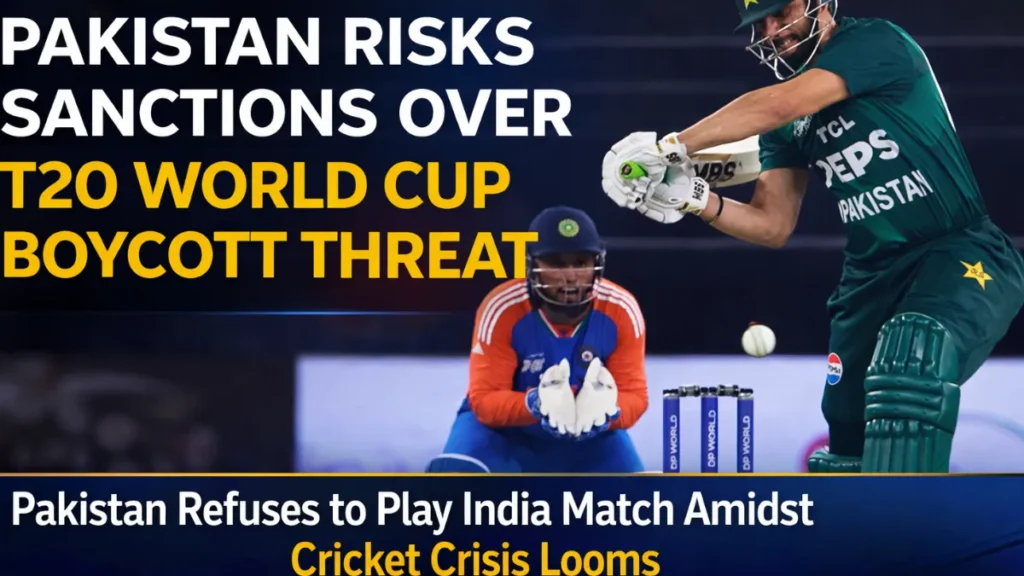
Just days before the tournament, the Pakistan government and the Pakistan Cricket Board (PCB) indicated that while the team would participate in the World Cup, it would boycott the high-voltage clash against India. No detailed reason has officially been provided yet.
This “partial participation” decision is unusual. Pakistan is not withdrawing from the tournament entirely, but is refusing to play one specific match — and that too against its biggest rival.
Such a step is rare in international cricket and has raised serious questions about the future of India-Pakistan matches in ICC tournaments.
PCB Yet to Make a Formal Statement
One of the most confusing aspects of this episode is the silence from the PCB. Although the Pakistan government made the announcement, the PCB has not released a detailed official statement.
PCB chairman and Pakistan’s interior minister Mohsin Naqvi is expected to address the issue soon, but as of now, the ICC is reportedly waiting for formal communication.
This delay has only increased speculation and uncertainty around Pakistan Cricket T20 World Cup plans.
Why the India vs Pakistan Match Matters So Much
An India vs Pakistan match is not just another cricket game. It is the biggest event in world cricket in terms of:
- Viewership
- Sponsorship
- Advertising revenue
- Global fan engagement
These matches often break television and streaming records. Millions of fans across continents tune in, making it a financial backbone for ICC tournaments.
According to estimates, the commercial value of a single India-Pakistan game can reach close to USD 500 million when broadcast rights, advertising, ticket sales, and digital revenue are combined.
Losing such a match is not just an emotional blow for fans — it is a massive financial setback for global cricket.
Financial Trouble Looming for PCB?
Reports suggest the PCB could face serious financial consequences if it refuses to play.
Sources indicate:
- Pakistan could lose a share of ICC revenue
- PCB may face financial penalties
- Bilateral cricket agreements could be strained
- NOCs (No Objection Certificates) for overseas players in the Pakistan Super League may become harder to secure
In simple terms, this decision could impact Pakistan cricket far beyond one World Cup match.
ICC’s Next Move: Emergency Meetings
The ICC now finds itself in a difficult position. It must balance:
- Tournament integrity
- Financial interests
- Political sensitivity
- Fair treatment for all teams
Reports suggest the ICC is preparing to hold a board meeting within 48 hours to decide on possible action.
Any decision the ICC makes will set a precedent for future tournaments. If they are too strict, it may escalate tensions. If they are too lenient, it may encourage similar actions by other teams.
Reactions from Cricket Legends
Sunil Gavaskar’s Strong Words
Indian legend Sunil Gavaskar has openly stated that a last-minute withdrawal is a serious issue.
He believes the ICC should take action to ensure no team considers such steps in the future. Gavaskar also suggested legal action could be a possibility if Pakistan refuses to play.
His comments reflect the seriousness with which former players are viewing this controversy.
Harbhajan Singh Questions PCB’s Resolve
Harbhajan Singh has been vocal in his criticism. He questioned whether the PCB would stick to its decision under pressure or eventually change its stance.
According to him, this has become a matter of pride and conviction for Pakistan cricket authorities.
Rashid Latif’s Counter View
Former Pakistan cricketer Rashid Latif believes the ICC might hesitate to act harshly. He argues that the support Pakistan and Bangladesh can generate could influence ICC decisions.
His view highlights that this issue is not just about rules but also about power dynamics in world cricket.
Impact on India’s Qualification Scenario
If Pakistan does not show up, India could receive default points. This would make India’s path to qualification easier.
However, some experts believe not facing a strong opponent like Pakistan before the knockout stages could reduce competitive sharpness.
For players like Suryakumar Yadav and the Indian squad, high-pressure matches often serve as preparation for later rounds.
Trouble for Pakistan on the Field
From a purely cricketing perspective, this decision could hurt Pakistan.
With fewer group matches to rely on, every remaining game becomes crucial. A single slip-up could end their Pakistan Cricket T20 World Cup journey early.
Tournament momentum is important, and controversies off the field can distract players on it.
A Growing Rift in Subcontinental Cricket?
This development comes after Bangladesh also showed signs of distancing itself earlier. Many experts fear that cricket relationships in the subcontinent are becoming strained.
If major Asian teams begin pulling away from each other, it could affect:
- Asia Cup tournaments
- Bilateral series
- Multi-nation events
- Overall cricket unity in the region
Cricket in South Asia thrives on rivalries, but it also depends on cooperation.
Is This a Real Boycott or a Pressure Tactic?
Some analysts believe this could be a strategic move to pressure the ICC or send a political message.
Questions being asked include:
- Will Pakistan refuse to play India later in the tournament too?
- Could the decision be reversed?
- Is this a negotiating tactic?
If the stance changes later, critics may call it a hollow threat. If it remains firm, the consequences could be severe.
Commercial Headache for Global Cricket
Sponsors and broadcasters invest heavily expecting blockbuster India-Pakistan matches.
Without that fixture:
- Advertisers lose prime slots
- Broadcasters lose viewership spikes
- Ticket sales suffer
- Digital platforms lose engagement
This is why the Pakistan Cricket T20 World Cup boycott talk is not just a cricket issue — it is a business crisis.
India Sticking to Its Travel Plans
Reports indicate that India will still follow protocol and travel to Colombo as originally planned. This keeps their preparation and schedule intact.
It also sends a message that India is ready to play as per tournament rules.
What Could Happen Next?
Several possibilities exist:
Scenario 1: Pakistan Reconsiders
Diplomatic talks or ICC negotiations may lead to a reversal.
Scenario 2: ICC Imposes Penalties
Fines, revenue cuts, or legal action could follow.
Scenario 3: Match Awarded to India
India may receive points without a game.
Scenario 4: Long-Term Fallout
Future India-Pakistan matches may face uncertainty.
Fans Caught in the Middle
At the end of the day, it is the fans who lose the most. India vs Pakistan games create unforgettable moments, historic performances, and global excitement.
Millions were waiting for another chapter in this rivalry. Instead, they are watching a political and administrative drama unfold.
The Bigger Picture for Pakistan Cricket T20 World Cup Campaign
The Pakistan Cricket T20 World Cup story is no longer just about tactics, players, or form. It has become a test of diplomacy, governance, and cricket politics.
How PCB and ICC handle this will shape the future of international cricket relations.
One thing is certain — the world will be watching closely.
Conclusion
The T20 World Cup is meant to celebrate cricket, not divide it. While boards and governments make decisions based on national interests, the spirit of the game depends on competition and sportsmanship.
Whether this boycott stands or not, it has already left a mark on the tournament.
The coming days will decide if this turns into a historic standoff or a resolved dispute. Until then, the Pakistan Cricket T20 World Cup campaign remains under a cloud of uncertainty.